

Planning the London 2012 Olympic Park: An interview with Guy Briggs
An interview with Guy Briggs who worked on the master plan for the 2012 Olympic Games in London, and regeneration strategy for the Lower Lea Valley where the Olympic Games took place. (This piece was originally published in August 2012)
Rashiq Fataar: Can you describe your role in the planning of the London Olympic Park and how your involvement in the Lower Lea Valley regeneration strategy came about?
Guys Briggs: I led the consultant team that prepared the regeneration strategy for the Lower Lea Valley – this is the wider area in which the Olympic Park is situated – which established the spatial and regeneration context for the Games and its Legacy. At the time I was urban design director at design consultancy EDAW (now part of the AECOM group), which was appointed by the London Development Agency to prepare the master plans for the Games and Legacy, after winning a competition in 2003. After initially working as part of the Olympic master planning team, specifically on the legacy planning, I was asked to lead the regeneration team.
Rashiq Fataar: What key conditions needed to align — politically, financially and spatially — to transform such a large, contaminated and historically neglected site?
Guys Briggs: The most critical element is political will. In 2000, Ken Livingstone became the first elected Mayor of London, with executive powers. With a background on the far left of British politics, he brought with him a mandate to deliver change for working-class London, in particular driving investment into the historically disadvantaged eastern part of the city.
The second element is vision. Livingstone decided to bid for the Olympic Games to be hosted in London, not so much because he wanted London to be an Olympic City, but because he needed a Big Idea that he could develop a consensus around. Initially no-one thought London would win the bid – Paris was the clear favourite – but the idea was that the energy galvanised around the bid could then be harnessed to deliver the regeneration as a ‘consolation prize’ after London lost.
The announcement on 6 July 2005 that London would host the 2012 Games took everyone by surprise (not just the Parisians). It’s ironic that in some respects therefore the means became the end – i.e. while an Olympic bid was intended to just be part of a broader process of regeneration, after 2005 the delivery of the Olympic Games became an almost all-consuming task in itself. However, in the long term the impact of hosting the Games, rather than simply using an unsuccessful bid to galvanise local communities, will be much greater.
Livingstone decided to bid for the Olympic Games to be hosted in London, not so much because he wanted London to be an Olympic City, but because he needed a Big Idea that he could develop a consensus around.
The third element is money. The cost of hosting the Games is enormous. From an initial budget of around £2 billion (around R26 billion) during the bidding stage, revised budgets in 2006 saw costs ballooning to a massive £9 billion (R117 billion). Much of this cash was required to clear the site and develop the bulk infrastructure – transport, energy, waste disposal, etc. – needed to host the Games. The infrastructure will be recycled/reused for the Legacy development that incorporates the Olympic Park back into the surrounding city, so much of the cost is not wasted, however, the amount of money required simply to stage the Games is still enormous.
One could argue that this is wasteful expenditure, on the other hand, had London not hosted the Games, the Lower Lea Valley would not have been the development priority that it became, and it would have taken many more years to bring this level of infrastructure investment into the area, particularly after the 2008 financial crisis.
The fourth element is the deadline – an event such as the Olympics provides an immovable deadline. There is no option to push back delivery dates to suit availability of funds or any other convenience. It HAS to happen.
Rashiq Fataar: What proved most complex in planning for this site — politically, geographically or institutionally?
Guys Briggs: This was a hugely complex project, not least in scale (the Olympic Park covers 250 hectares, and the wider regeneration strategy covers 1500 hectares). First and foremost amongst the difficulties must be the political geography. Both the Olympic Park and the wider regeneration area straddled borough boundaries*, with the area falling into four local boroughs (Hackney, Newham, Tower Hamlets and Waltham Forest). The planning process needed to achieve the support of each of these boroughs (all with their own particular agendas), as well as the Greater London Authority (GLA), and separate planning applications had to be made to each authority. The physical geography was another major difficulty. The Lower Lea Valley has been an industrial area and waste dumping ground for centuries.
Apart from the extensive ground contamination by acids, oils and other chemicals, the area is divided up by the extensive industrial transport infrastructure required in different industrial epochs – 18th century canals, 19th century railways and 20th century highways. To further complicate matters, two sets of major power lines ran the length of the valley, right across the site identified for the Games – and the power company (National Grid) was adamant that only an Act of Parliament would compel them to put them underground. They were duly compelled …
The Olympic requirements themselves were no less onerous. Probably the highest concern, and the greatest impact on the planning process, was security – ever since the tragic 1972 Munich Olympics, the safety of all involved in the Games has been absolutely paramount. This raises extraordinary logistical problems, with the movement of athletes and Olympic officials around the park – between venues and the village – entirely separated from movement by the general public. Spectator access and travel is in itself a major challenge – how do you allow several hundred thousand people in and out of the park every day without creating enormous pedestrian traffic jams? Anyone who’s travelled Cape Town’s fan walk for a major game in Green Point (with a maximum of 54,000 spectators) will appreciate how chaotic this can be.
*The political structure of London is made up of 32 local boroughs plus the independent City of London (the financial district). In 2000 the Greater London Authority was introduced with overall strategic authority for issues of cross-borough or London wide significance.
Rashiq Fataar: Professor Ricky Burdett has suggested that the real benefits of the Olympic Park will only be visible decades from now, and that it should ultimately read as an extension of the city. Do you agree?
Guys Briggs: The whole purpose of hosting the Games was for them to act as a catalyst for major change and regeneration in London’s East End. Much of this change will only be seen in future decades when there are established residential and working communities in the Olympic Park, and the surrounding neighbourhoods have gone through their own cycle of change and regeneration.
But there are tangible benefits already. The new transport links in the Lower Lea Valley have massively improved access in and through the area. Acres of derelict and degraded land have been cleaned up, and new development has taken place bringing housing, parks and community facilities into this deprived area. But although there will be many winners in this regeneration process, there are also losers. Many businesses were forced to close down, or relocate – taking jobs with them.
As to it being an extension of the city grid – this also remains to be seen. in any event, Grid is something of a misnomer; unlike New York, London is not famous for being built to a grid. I prefer to talk about the city’s structure.
A long established community of allotment gardeners were displaced from the heart of what is now the Olympic Park. And the extent to which local residents will be displaced by rising property values remains to be seen. But one of the greatest injuries is to the soul of the city. London has lost one of its secret places – a place that the marginal and displaced could call home – and on the evidence of what has been built for the Athletes’ Village, will replace it with a characterless nowhere-land.
As to it being an extension of the city grid – this also remains to be seen. in any event, Grid is something of a misnomer; unlike New York, London is not famous for being built to a grid. I prefer to talk about the city’s structure. Certainly it is the intention that the redevelopment of the Olympic Park after the Games will erase the Olympic Park’s boundaries, and see it reabsorbed into the surrounding urban fabric. This will require that the existing structure of streets and spaces outside of the Olympic Park is extended into the Olympic Park area, with many new bridges over the canals, highways and railways. This was at the heart of the original planning for Legacy – I only hope that budget constraints do not end up cutting out the crucial linkages that have been planned, and so retain the area’s isolation.
Rashiq Fataar: Has meaningful integration with surrounding communities begun — or is that still largely a future ambition?§
Guy Briggs: Not yet. If anything, by creating an enormous locked-down high-security development site in the middle of the Lower Lea Valley for the last 6 years, the Olympic Park has determinedly isolated itself from the surrounding communities, and furthered their isolation from one another.
Future integration is certainly the desire, but its achievement is dependent on the continued flow of investment to deliver the promised infrastructure.
Rashiq Fataar: Do you feel the delivered Olympic Park remains broadly consistent with the original regeneration vision?
Guy Briggs: As far as the Olympic Park is concerned, yes certainly. There are elements that haven’t turned out as we originally envisaged, but this is inevitable in a project of this nature. I think the team that has delivered the Olympic Park has done an incredible job. But the Legacy product is much more important, and we don’t know yet whether that will deliver to the original vision.
Rashiq Fataar: Do you have a favourite venue in the Park — and what makes it stand out to you?
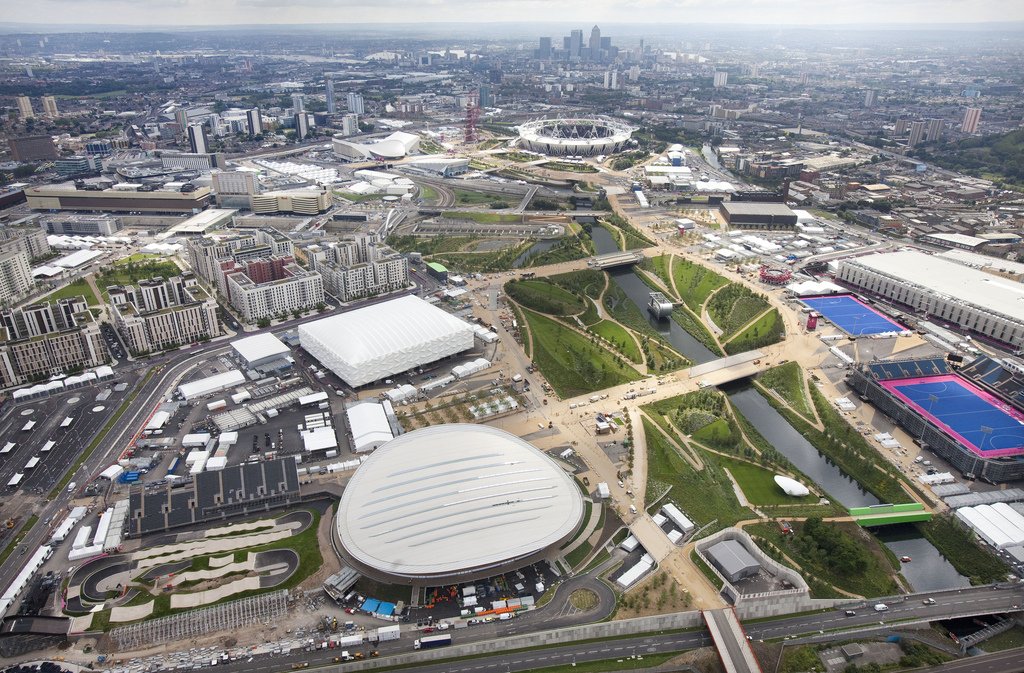
Guy Briggs: The velodrome! It’s quite simply a very beautiful building, that encapsulates its function, sits serenely on the site, and marks the northern gateway to the Olympic Park. It’s one of only four venues in the Olympic Park that will be retained after the Games – and I think the only one that will not be downscaled in ‘Legacy mode’. Hopkins Architects were therefore spared the challenge of designing a building to be one thing for the Games, and another afterwards. Their design therefore benefits from a unity of purpose – and it shows! The velodrome manages to be both highly functional and remarkably poetic – something every architect should aspire to achieve.
Rashiq Fataar: What should Cape Town take from London’s experience if it were to pursue large-scale regeneration anchored around major infrastructure or events? And in reflecting on Green Point, where were the missed opportunities?
Guy Briggs: On the whole, I think the development of Cape Town’s Green Point Stadium, and its surrounding park, is incredibly successful. The integration of the stadium and park, together with the soon to be completed athletics stadium, will create a world class sports and leisure complex of which Capetonians can and should be proud. The integration of this complex with the city via the fan walk is also highly successful, and anyone who argues that in siting the stadium and park in Green Point the city has catered only for the elite, has clearly never been there on the weekend when the park is claimed by Capetonians from all over the city.
But there are flaws: the transport links are far from perfect, although the extension of the MyCiti transit system, including the feeder route along Somerset Road, will significantly improve this. The failure of the city to secure a long term legacy use for the stadium (such as Western Province Rugby, or a premiership football team) is unfortunate – but interestingly precisely the same issue is still being debated in London. And the ongoing arguments over the future use of the stadium swing from one ridiculous extreme to the next.
Proper legacy planning, particularly in terms of the long term financial sustainability of the stadium, could have resolved most of this debate before it started.
The development of the stadium should have been brought forward in the context of a wider master plan incorporating other public sector land holdings in the area (such as the Somerset Hospital site), and working closely with the other major land holding – the V&A Waterfront. The aim of a proper legacy master plan would be to ensure that while the stadium was integrated into the recreation and sports complex created by the park to the west, it would also be knitted into the wider urban fabric of the city, especially to the east, with new development for leisure and commercial uses linking the stadium to the V&A. A legacy master plan could certainly have included a substantial housing component, especially affordable housing – which has been identified as a pressing need in the city.
So have we lost this opportunity? For now, at the stadium, possibly. But the lessons of London’s legacy planning are nevertheless valid. Cape Town has several other major development sites, and many areas for regeneration. The key lessons from London’s Olympic development, that you need political will, a Big Idea, money, and some sort of deadline to focus minds; can and should be applied to all of them.
