

How Barcelona used the Olympic Games to transform the city
This piece was originally published in August 2012 at Our Future Cities.
At the end of 2010, I found myself in Barcelona, stepping off a bus that had brought a group of us to the top of Montjuïc Hill, the site of the 1992 Summer Olympic Games.
It was not too difficult to understand why, beyond the post-Olympic success, the 17 days of the Olympic Games were a broadcaster’s dream. The dramatic Olympic Park, perched on Montjuïc Hill to the south-west of the city, overlooks much of Barcelona and its harbour. It forms a site of extraordinary presence, possibly unrivalled in location and setting until Rio de Janeiro hosted the Games in 2016.
On that day, the Estadi Olímpic Lluís Companys was closed for tours, but that did not stop me from peering through the iconic gates at one end of the stadium. I was searching for the ingredient that catapulted a relatively lesser-known Spanish city into the upper ranks of global tourist destinations.
But Barcelona’s rise was more than physical. It was more than an urban transformation made possible by spending. It was borne out of a vision and a will that had found life long before the Olympic flame was dramatically lit in July 1992. Perhaps the secrets I was looking for were not to be found inside the stadium or in the streets, but in the documents that recorded the journey towards the Games.
In a previous article in our Olympic Cities series, we interviewed Guy Briggs, who highlighted political will and clarity of vision as key components of London’s Olympic Park. With that in mind, I turned to the official reports of the Barcelona 1992 Olympic Games, which document the preparation and hosting of the Games from the bid through to the Closing Ceremony.
What emerges is not a story of a city transformed in 17 days, but one shaped over more than a decade.
Public space as a symbol of a new democracy
Following the end of the Franco regime in 1975, and the restoration of democratic local government in 1979, Barcelona faced the consequences of decades without coherent urban planning. Sprawl had taken root. Infrastructure was insufficient. Public space was limited.
In 1980, the newly democratic city government launched an ambitious programme of constructing public spaces. Squares, parks and neighbourhood upgrades were prioritised. These were not cosmetic projects. They were visible expressions of a new democratic era.
Public space became a symbol of change.
This work predated the Olympic award. It created the foundation upon which the Olympic bid could stand.
The decision to bid
In mid-1980, Mayor Narcís Serra, together with deputy mayors including Pasqual Maragall, began studying the possibility of hosting the Olympic Games. On 31 January 1981, Serra publicly announced Barcelona’s intention to bid for the 1992 Olympic Games.
The bid was not simply about becoming an Olympic city. It was about accelerating a broader urban project. When Barcelona was awarded the Games in October 1986, the city had already articulated a long-term strategy. The Olympics provided the momentum, the deadline and the global visibility to deliver it at pace.
Kick-starting infrastructure
Despite limited resources in the early 1980s, Barcelona resumed several major infrastructure projects. These included sections of the Ronda de Dalt and Ronda del Litoral ring roads, along with the completion of key tunnel connections such as the Rovira and Vallvidrera tunnels.
With the impetus of the Olympic Games, construction accelerated. The ring roads were redesigned not as urban motorways, but as integrated connectors between neighbourhoods and key sites. They would play a fundamental role in linking the various Olympic areas during the 1992 Games.
A new seafront
In 1987, redevelopment began on the Moll de la Fusta, reconnecting the historic city to the waterfront. This marked the first step in a much larger transformation of Barcelona’s seafront.
The industrial district of Poblenou was de-industrialised to make way for the Olympic Village. Beaches that had long been degraded were restored. Railway lines that separated neighbourhoods from the sea were reconfigured or removed. The city’s relationship with the Mediterranean was redefined.
The Olympics did not invent this ambition. They accelerated it.
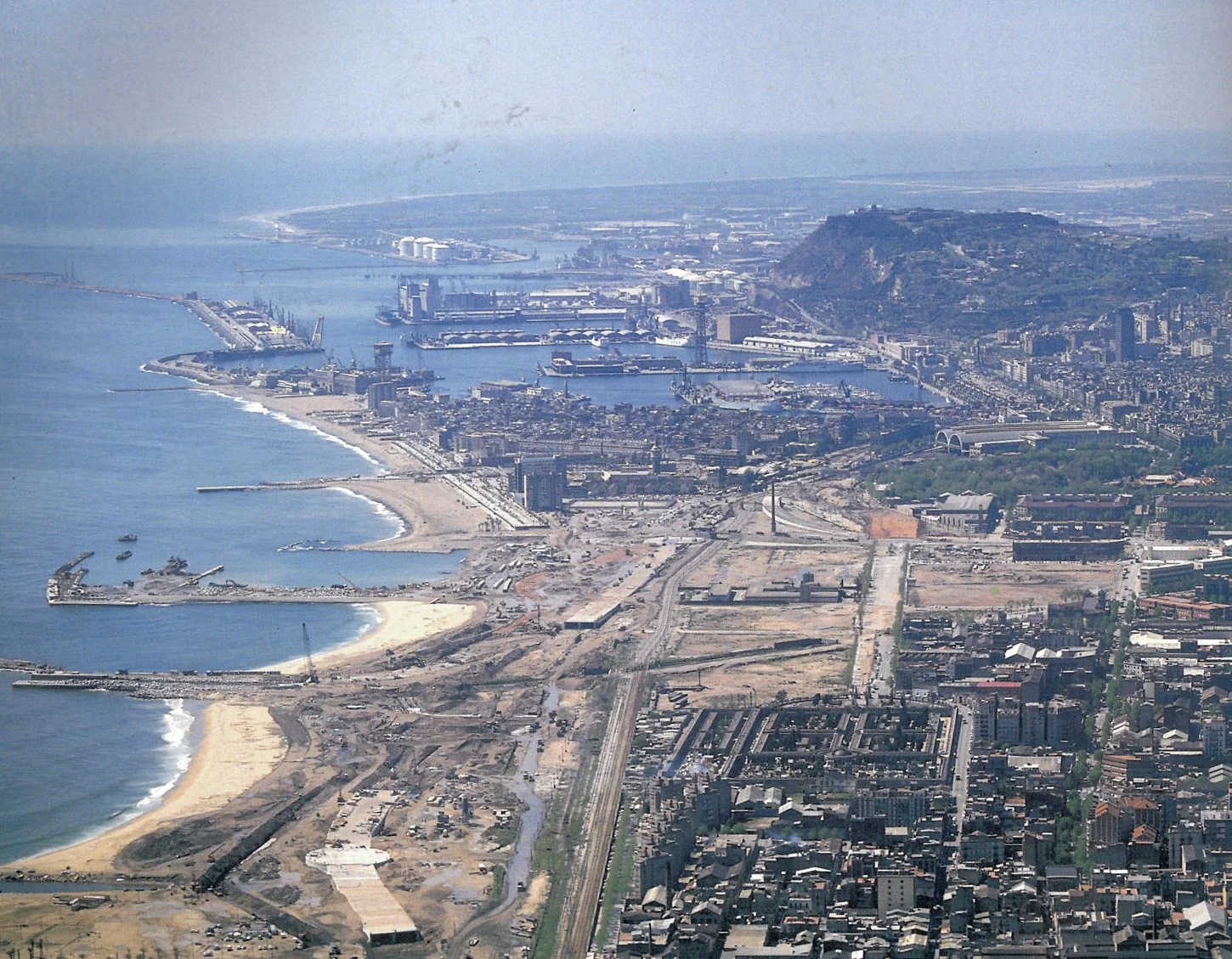
A view of the Barcelona waterfront before the Olympics, not accessible to the public and dominated by industrial uses.
The rings roads
In 1988, with the impetus of the Olympic Games, the construction of the ring roads was speeded up. This work followed the provisions of the 1976 General Metropolitan Plan, but abandoned the concept of “urban motorways”, adopted when some sections were to be constructed during the nineteen seventies. The new ring roads were designed to facilitate entry and exit from the city and to improve the connections between the main road network and the various areas of Barcelona. The new ring roads would also be a fundamental element in the links between the different Olympic areas during the 1992 Games.
Communicating with the world
The economic growth of the late 1980s brought rapid increases in demand for telecommunications infrastructure. Barcelona responded with major investment, including the construction of the Collserola Telecommunications Tower designed by Norman Foster, as well as facilities such as the Granada del Penedès Satellite Communications Complex.
These projects positioned Barcelona as an outward-looking European city, ready to communicate with the world.
The definition of the city centre
Over time the services district of Barcelona has shifted from the Ciutat Vella to the Example and more recently to the upper part of the Diagonal. For this reason, the large scale projects for 1992 have been concentrated in the peripheral and relatively inactive areas of the city to counteract the tendency for activity to concentrate in the southwest of the city, starting from the Diagonal.
A new cultural infrastructure
Barcelona’s designation as Olympic host also catalysed investment in cultural infrastructure. Projects included the renovation of the National Art Museum of Catalonia, the development of the Auditori de Barcelona, the National Theatre of Catalonia, and later the Barcelona Museum of Contemporary Art.
These institutions reinforced the city’s identity beyond sport. They embedded cultural ambition within the broader urban transformation.
Over more than a decade, a long-term vision for Barcelona was delivered step by step. The Olympic Games were not the origin of this transformation. They were its milestone.
The lesson is not that hosting the Olympics guarantees success. It is that when a city aligns a major event with an existing democratic mandate, a coherent planning framework and sustained political will, the event can accelerate what was already underway.
Barcelona did not build an Olympic city from scratch.
It used the Olympics to complete one.
